Showing posts with label interview. Show all posts

Wednesday, October 9, 2019

The journey of self-discovery in Abbigail Rosewood's If I Had Two Lives #DiverseBooks #Giveaway


About the book

This luminous debut novel, which has earned impressive early reviews from media including The New Yorker, The Los Angeles Review of Books and Foreword Reviews, follows a young woman from her childhood in Vietnam to her life as an immigrant in the United States – and her necessary return to her homeland.

As a child, isolated from the world in a secretive military encampment with her distant mother, she turns to a sympathetic soldier for affection and to the only other girl in the camp, forming two friendships that will shape the rest of her life.

As a young adult in New York, cut off from her native country and haunted by the scars of her youth, she is still in search of a home. She falls in love with a married woman who is the image of her childhood friend, and follows strangers because they remind her of her soldier. When tragedy arises, she must return to Vietnam to confront the memories of her youth – and recover her identity.

An inspiring meditation on love, loss, and the presence of a past that never dies, the novel explores the ancient question: Do we value the people in our lives because of who they are, or because of what we need them to be?

Publisher: Europa Editions
Release Date: April 9, 2019
Format: Paperback
ISBN-13: 9781609455217


Author Q&A

1. If I Had Two Lives tells the story of a young girl who has to confront issues of identity, alienation, abandonment as she tries to make a life in a new country. What inspired you to write this story?
I don’t think I was so much inspired as I was possessed⎯I was at a point when I was finally ready to use words as a means to construct emotional truths, difficult truths. The novel, as challenging as it was to write, is to me like a wish: a coherent, metaphorically consistent, emotionally logical narrative with a beginning, middle, and ending. A wish because life isn’t so neatly packaged and perhaps more metaphorically messy. In writing it, I was able to reframe the story from a young girl perspective even though everything that swirls around her is less than the ideal girlhood, dark, violent, disorienting. The perspective of a girl, especially one unnamed, is often dismissed. Here, everything is filtered through her eyes. The second half of the novel is set in New York, where she ends up. This part was also exciting for me to write because I knew most Americans associate Vietnam with the Vietnam war, and I wanted to offer something different. Vietnam and Vietnamese people have lives and experiences that go beyond a single historical event. It was important for me to break out of this predetermined framework.

2. Where did you get the idea for this novel?

It would be dishonest for me to pinpoint exactly where my ideas come as the creative process can be elusive and hard to describe. Other artists have done it better than I ever could, but I think my taste is my guidance. One of my favorite movies is Pan’s Labyrinth, which follows a young girl’s perspective, or really, her imagination, as she navigates a landscape full of human horror, war, violence, child abuse, the loss of a parent, etc. Through her the viewer witnesses the unfolding of a dark fairy tale. I think children who have lived through violence, in many ways have never had the luxury of being children, but they also can’t help but be children. Their imagination helps them cope and is also a way for them to reclaim the narrative, to make sense of all the terrible and nonsensical things in the adult world. 

3. Are any of the experiences of the main character pulled from your own life?

My novel is an amalgamation of factually accurate information, the unreliability of my own memory, creative freedom, a good amount of psychosis, and that magical elixir that transforms madness into art.

4. What kind of research did you have to do for this novel?

The short answer is none. The long one is everything I’ve read, loved, hated, have contributed to who I’ve become as a writer. 

5. Your book focuses on a number of different female relationships, including a complicated mother/daughter relationship and female friendships. Why was it important to showcase those relationships in your novel?

I’m fascinated by female relationships, their mythic quality, complexity, and the fact that most of them involved unresolved grief. I think the best literary male friendships are also very feminine. In my novel, I was also interested in exploring the juxtaposition between what is typically deemed as masculine⎯a military compound, soldiers, etc. and the more feminine energy⎯a girl going bra-fitting, her first masturbation, etc. These opposing forces sharing the same space create a delightful effect that could potentially subvert expectations.

6. One of the themes in your book is grappling with the past. Why do you feel it’s important for people to confront their memories and history?

I actually think so much of the world’s problems originate from our inability to acknowledge our shadow, our darkness, our refusal to reflect. So many of the world leaders, past and present, have created havoc for humanity because they need to prove their self-worth by accumulating wealth and power. If we don’t grapple with our memories and our history and try to understand our own darkness, then our shadow will end up taking precedence. Free-will is not doing whatever we like or having knee-jerk reactions. Free-will is knowing precisely why we act the way we do.

7. Ultimately, what do you hope readers take away from your novel?

I hope for my novel to challenge, entertain, delight. But perhaps more than anything, I would feel successful if someone somewhere reads a line and feels its truth whether or not they can relate to it.

8. How/where can readers purchase If I Had Two Lives?

Everywhere books are sold. I recommend supporting your local independent bookstores. 

9. What else are you working on now?

I’m editing the last draft of my second novel and starting my next project.

About the author
Abbigail N. Rosewood was born in Vietnam, where she lived until the age of twelve. She holds an MFA in creative writing from Columbia University. An excerpt from her first novel won first place in the Writers Workshop of Asheville Literary Fiction Contest. She lives in New York City.

Visit Abbigail


Giveaway
A print copy of If I Had Two Lives. Giveaway is open to U.S. only and ends on October 23, 2019 midnight central time. Entries are accepted via Rafflecopter only.

a Rafflecopter giveaway


Never miss a post!

* indicates required


Wednesday, October 2, 2019

Kelly Watt's Mad Dog resonates strongly in the #MeToo era #Giveaway

About the book
It's the summer of 1964 and the Supremes are the reigning queens of radio. Sheryl-Anne MacRae dreams of running away from her home on an apple orchard in southwestern Ontario to find her missing mother. But the teenager's plans are put on hold when her uncle and guardian, Fergus, the local pharmacist and an amateur photographer, brings home a handsome young hitchhiker.

When Sheryl-Anne meets the guitar-toting Peter Lucas Angelo, she falls in love. But life in Eden Valley is not as idyllic as it seems. As the summer progresses, Peter is pulled deeper into Fergus' dangerous underworld – a world of sex, drugs, pornography and apocalyptic visions.

Through the naïve eyes of the ethereal 14-year old Sheryl-Anne, Kelly Watt explores themes of child abuse and sexual deviance, and the secrets, dissociation and denial that allow it to flourish.

A gothic tale told in vivid, often hallucinogenic prose, Mad Dog was a 2001 Globe and Mail notable book and Watt's first novel. The book has been republished with a U.S. publisher (an updated edition).

Publisher: Hamilton Stone Editions 
Release Date: September 2, 2019 (revised edition; first U.S. edition) 
Format: Paperback 
ISBN-13: 9780990376705

Author Q&A

1. Mad Dog tells the story of a young girl experiencing very traumatic events. What inspired you to write this story?

In my late-twenties and early thirties, I went into therapy after years of struggling with insomnia, depression, and anxiety. I ended up spending six years experiencing terrible flashbacks of abuse I’d suffered as a child while living in various boarding and foster homes. One of the ways I kept sane was to journal. I felt that if I could write one sentence a day then I would be okay. I began journaling, and the writing started spiralling off into stories. Mad Dog started as a story, but it just kept getting longer and longer until I had to admit I was writing a novel.

While in therapy, I had a flashback that really haunted me about a troubled young man. I was trying to figure out why this teenager voluntarily hung around this abusive group of men. He was being sexually abused by one of the men and they were taking pornographic photographs of him.

I posed myself a question: why would a boy be lured by these men? What would be the appeal? What would he be fleeing, what were his vulnerabilities and how would the perpetrator convince him to stay? I wrote the book to answer those questions for myself.

There wasn’t much known about grooming or the tactics of predators or pedophiles in those days, so I just posed the question, “why?” And wrote a book about it. I was trying to come to terms with my own violent childhood, much of which remained opaque and inexplicable to me at first. I was trying to understand what kind of people would behave in such a predatory way and why.

2. Are any of the experiences of the main character pulled from your own life?

Yes, some of the experiences in the book have been pulled from my own life. Others are fictionalized. A book becomes its own creature after a while.

Sheryl-Anne’s whole desire in life is to reunite with her mother, and that was mine too. I lived apart from my mother off and on from age 2-11. I spent my early days feeling abandoned and longing to be united with her. I was also abused and manipulated in some of the ways Sheryl is in the book and had total amnesia about it for many years, as Sheryl does.

3. What other personal experiences did you want to explore in this novel?

I wanted to write about dissociation, denial and amnesia – that process of burying what’s painful. Of being half alive or sleepwalking through life, because of trauma and fear. Due to my own trauma, I felt that I was awakening from a deep drug-induced sleep or hypnosis.

All my life I had felt tormented, and I hadn’t known why. I would say to my therapist over and over that there was something I wasn’t remembering…but I couldn’t finish the sentence. Then the truth of my childhood came to the surface. And it was horrific. It was a huge shock that led me to question everything. Suddenly I was aware of the unfairness in the world, the way certain powerful men got away with abusing their power, how secrets are held and enforced.

My awakening was at a much later age, but I wanted my character, Sheryl-Anne, to have her awakening as a young woman, so that she could know and escape.

4. This novel was originally published in 2001. Why release a revised edition now?

Mad Dog was originally launched on September 13, 2001. My beloved stepfather died on September 4, and of course then there was 9/11. So, what I anticipated as being one of the greatest times of my life, became the worst.

I also felt that it was too soon. People were still uncomfortable with the subject matter at that time. I had people say to me that child pornography was just a rumour and grossly exaggerated. The internet wasn’t flourishing yet, so people were still very naïve about child sexual abuse and human trafficking, etc. I got involved with an independent press in the U.S., Hamilton Stone Editions, and they asked me to publish the book with them. I kept saying no, there were just too many painful memories around it. But as the #MeToo movement began and I realized people were more open to this topic now than 20 years ago, I relented.

5. How does this story resonate in the current #MeToo era?

Society is finally accepting that sexual harassment and assault takes place, and in unprecedented numbers, and the public is finally supporting women who come forward. So, I think now people will finally understand that these same things happen to young girls and children, as in my novel.

6. Mad Dog takes place in 1964. How different was that era for women and children who experienced sexual assault compared to today?

I picked that year because it was the pivotal year before the 50s became the 60s. When we talk of the 1960s, we are usually referring to that groovy time from 1965 onwards. Before that the staid, post-war 1950s were still the status quo. I wanted that conservatism, and the old boys club atmosphere that was rife in small towns at that time, as a backdrop to Sheryl’s discoveries.

When it came to my own research into the justice system, I found out that crimes committed are tried by the law of the time, no matter when you come forward. And in the 1960s there were no trafficking laws in Canada, no child pornography laws, only an obscenity law, and even that required a witness. I was told someone would have had to witness my rape for me to win in court. So you can imagine the likelihood of that. In most cases of rape the only other person present is the perpetrator, so you can surmise how many of those cases were ever solved in favour of the victim.

Basically, women and children were not protected under the law when it came to sexual violence. It didn’t exist in Canada. And still doesn’t in many places around the world.

Fortunately, #MeToo has kicked the door open. Whether the door stays open and women get to pass through it and receive justice and healing is another thing. Public opinion tends to swing like a pendulum and there can be a backlash.

7. What kind of research did you do for this book?

I did quite a bit of research for the book. I didn’t grow up on an apple farm, for instance. I was a city kid who had spent time in a small town in the country, so I had to do a lot of research when it came to rural farming life. I liked the allegorical nature of apples, and so set the book on an apple orchard. I asked some very nice fruit farmers outside a northern town for their help, and I interviewed them and hung out and worked with them for a while during harvest season so that I could get a sense of rural life. I always felt a bit badly that the farmer characters in the book are such bad actors, because the people who let me hang out and learn about apples from them were truly wonderful people.

I also spoke with many other survivors of what we call ritualized abuse and torture, or intergenerational sex rings, and so I had a sense of the dynamics that occur in these sick pedophilic family groups, and their gang-like behaviour.

8. Ultimately, what do you hope readers take away from your novel?

I want to raise awareness about these issues – about the prevalence of child sexual abuse and its long-term effects, and particularly the tactics that predators use to lure their victims. Although the book takes place many years ago, the techniques pedophiles and traffickers use then and now are essentially the same – the flattery, the stringing along, the promises, the offers of gifts, free drugs and alcohol and sex, all that is typical grooming behaviour. As parents we need to be aware of them.

One of the things that the recent case around Jeffrey Epstein has highlighted is how a predator can use other victims to lure new victims. Sadly, predators take advantage of our innocent assumptions, including that a woman wouldn’t help a predator, and yet there are many instances where that is not true. Predators often work in pairs. Even Weinstein had helpers. So did Epstein. That other woman in the car or the woman who invites you to the party, may also be a victim, may be programmed and manipulated, or just plain innocent of what’s about to take place. It’s so tragic.

So, the first step is to share and discuss these issues to get the information out there. I’ve added a reader’s discussion page at the back of my book, and I’ve been offering to do book clubs so that people can get together and discuss these issues, in a safe setting, either in person or by webinar, so that they have a forum to share their experiences.

I’ve also created a resource page with places to get help in the U.S. and Canada, as well as a list of social justice organizations like the one I used to volunteer for so people can access them. There are a lot of amazing resources out there now, but people need to be aware of them. I’ve started a weekly blog on some of these issues for the purposes of sharing info and related news events. You can find all this information on www.kellywatt.ca.

It’s secrecy that allows these crimes to flourish. If we want to keep our children safe from pedophiles and traffickers, then we need to be open and get the information out there.

9. Where can readers purchase Mad Dog?

The new book is available on Amazon.com, both in paperback and Kindle and Smashwords.

10. Is there anything else you’d like to tell us about your journey?
First, I think that it’s important to be kind when people divulge their experiences of trauma and violence to you. It takes a lot of courage to come forward and it’s important that we allow people to speak their truth.

The second thing is that it takes years to heal, sometimes many, many years. I look like a normal person, but the truth is I have spent almost 30 years in therapy. I consider myself a fully recovered survivor, not a victim.

Lastly, no matter what has happened to you, you can heal. What the people of my generation did was learn and develop new modalities of healing, and they are available now. No matter how dark the present, there is hope for the future. The world is changing.

About the author
Kelly Watt’s award-winning short stories have been anthologized, published internationally and longlisted for the prestigious CBC Radio’s Short Fiction Contest twice (2017/2015). She is the author of two books—the travel companion Camino Meditations (2014), and the gothic novel Mad Dog (2019). Watt lives in the Ontario countryside with her husband, a miniature schnauzer and three diligent chickens.

Visit Kelly on Facebook.


Giveaway
A print copy of Mad Dog. Giveaway is open to U.S. only and ends on October 16, 2019 midnight central time. Entries are accepted via Rafflecopter only.


a Rafflecopter giveaway


Never miss a post!

* indicates required

Wednesday, February 15, 2017

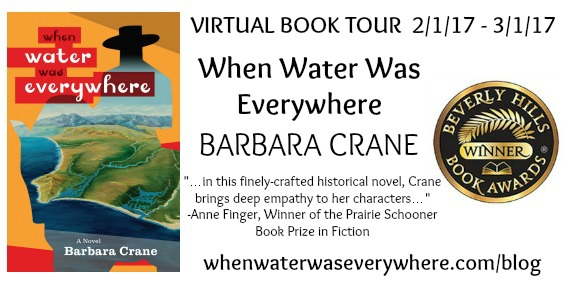
Q & A with author Barbara Crane #Giveaway Signed paperback of When Water Was Everywhere


Q&A WITH BARBARA CRANE

Where did the idea for your novel come from?

My novel emerged from days of crisscrossing the Los Angeles Basin by automobile—sometimes putting 15,000 to 20,000 miles a year on my car during my work as an independent writer and corporate trainer. As I crossed overpasses high above the land, I often turned north toward the soaring transverse range. Known in our time as the San Gabriel Mountains, they ring the Los Angeles Basin. I wondered, “What did the first people on this land think about living in the shadow of these magnificent mountains?”

I crossed over the Los Angeles River, saw it encased in its concrete channel, and wondered what the rivers looked like when they ran freely. I drove along the coast and imagined ships full of adventurers, explorers and holy men who came to California as early as the 16th century, changing the landscape, people and culture forever. I began to infuse my imaginings with the people who lived here when Los Angeles was a pueblo. Those people—a few Mexican and American settlers, the indigenous Tongva Indians, and the Spanish missionaries people my novel.

Is this a true story?

When Water Was Everywhere is historical fiction. Although the story is fiction, most of it is historically accurate because it is based on more than a decade of research on the pueblo of Los Angeles and the lives of the Tongva/Gabrieleno Indians in the early 1840s. I researched the padres and Indians at the California missions, specifically the Mission San Gabriel. I especially enjoyed delving into the history of our two historic ranchos in Long Beach, particularly Rancho Los Cerritos, where a good deal of the action in the novel takes place.


Are the characters based on real lives?

One of the four major characters is inspired by John Temple, a wealthy businessman and owner of the first store in the pueblo of Los Angeles. Don Juan Temple, as he was called, bought a part of the original Nieto land grant that borders the Los Angeles River on the west and, today, the San Gabriel River on the east. Today, those 325,000 acres that constituted the Nieto land grant have become seven cities. John Temple purchased Rancho Los Cerritos, which comprised 27,000 acres of the Nieto grant in 1843. Much of the action in When Water Was Everywhere takes place as Temple’s (Rodrigo Tilman’s) ranch house was being constructed.

Who are your favorite writers?

My favorite novel is Zora Neale Hurston’s Their Eyes Were Watching God. I’ve read it nine times. I love Toni Morrison, Gabriel García Márquez, Nadine Gordimer, Jonathan Franzen, Jumpha Lumphiri. Holly Prado Northup, Louise Glück and W.S. Merwin are some of my favorite poets. I read writers from all over the world--Japan, Africa, Nepal, Costa Rica, Mexico. I want to know about other places and other people, and I think books are a good way to know them.


Barbara Crane is an award-winning novelist and short story writer. Her 2016 release, When Water Was Everywhere, won a Beverly Hills Book Award. Her 2001 novel, The Oldest Things in the World, was a ForeWord magazine Book of the Year. Crane’s short stories and nonfiction have appeared in the Los Angeles Times, The Sun, Birmingham Arts Journal, and the Outrider Press Black and White Anthology series. Barbara has enjoyed careers as a business journalist, teacher, and corporate communications consultant. A native Los Angelino, Barbara took her degree from UC Berkeley. She lives in Long Beach with her husband.

Visit Barbara's website: www.barbaraecrane.com

Find out more about When Water Was Everywhere: www.whenwaterwaseverywhere.com

Purchase a copy at Amazon

GIVEAWAY
Up for grabs...a signed paperback edition of When Water Was Everywhere. Open to U.S. entries only. Please leave a comment with an email address for winner contact. Giveaway is open through Wednesday, March 1, 2017. Good luck!


Photobucket

Never miss a post!

* indicates required

Wednesday, June 1, 2016

Step Back in Time: An interview with authors Elisabeth Storrs and GS Johnston {Giveaway}


Step Back in Time: An interview with Elisabeth Storrs, author of The Tales of Ancient Rome Saga and GS Johnston, author of The Cast of a Hand

GJ: Thoughts of ancient Rome have always entertained me. When I was very young I was obsessed with the idea of Roman amphitheatres, that their open-air design could somehow help carry the human voice. At school, I remember reading Shakespeare’s Julius Caesar and then Antony and Cleopatra and then wandering the teenage streets of Hobart thinking how different they must be to ancient Rome. But years later when I wandered the streets of the ancient Roman Forum, I realised how similar they were. The basic layout of buildings along a street is much the same and Hobart is full of Victorian architecture with all its overtures to Roman; the columns, the dance of curved and triangular window awnings.

In many ways, Elisabeth Storrs writing of the Etruscans takes us back another step, to a time when Rome itself was forming, at the one time defending and expanding itself.

So with the release of the third part of this triptych, let’s step back in time...

GJ: Has writing always been part of your life?

ES: I always wanted to be a writer from a very early age and wrote short stories and poetry that was published in journals in my twenties but then ‘life got in the way.’ It wasn’t until I had my children that I realised I would never finish a novel unless I set aside time in my diary. And so I wrote for a couple of hours each week by hiring a school kid to babysit my boys. And from little things, big things grow. It’s amazing what you can achieve by slowly chipping away. It took years but I finally completed my first manuscript (which is now in a bottom drawer.) Eventually my writing time increased as my family grew older. Now I’ve been given the opportunity to write everyday – I love it. So much better than being a lawyer!

GJ: What was the first inkling you had of your early Roman series, especially Call to Juno? And how did it proceed from there.

ES: I’ve always loved myths and legends and studied history and ‘dead’ languages at school and university. As a result, I read history books when I had the chance. Over fifteen years ago, I discovered a photo of a 6th century sarcophagus with a life size couple depicted lying together on their bed. The casket was unusual for that period because women were not usually commemorated in funerary art. Discovering the society that portrayed such tender affection led me to Etruria and the little known story of the siege between Rome and the Etruscan city of Veii. From there the tale was born of a young Roman treaty bride, Caecilia, who is married against her will to an enemy nobleman, Vel Mastarna, to seal a truce. The world of the Etruscans has absorbed me ever since. It took ten years to write The Wedding Shroud (after three rewrites), 18 months to write The Golden Dice, and 12 months to finish Call to Juno (practice does help you write faster!)

GJ: That’s a sustained effort. When I first went to Europe in in the 80s, I remember seeing the Etruscan wall and gate in Perugia and being surprised beyond belief at the size and strength of it. They were a major civilisation. With your first idea for the series, how much planning had you done for the second and third instalments when you were writing the first part? And how much did the second and third parts evolve as you wrote them?

ES: I originally wrote the entire plotline of Caecilia and Mastarna’s love story in one book but it was far too long so my agent suggested I split The Wedding Shroud in half. When I came to write the second book, The Golden Dice, I realised I needed to include a Roman viewpoint so I introduced Pinna, the tomb whore, who connives her way to become an army wife and meets and falls in love with Camillus, Rome’s greatest general. Creating the Etruscan unwed mother, Semni, allowed me to present the life of a commoner in those times. She becomes integral in ensuring the survival of the young heirs of the House of Mastarna. In Call to Juno, I wrote through the eyes of the repressed gay Roman soldier, Marcus, to enable readers to enter battles and political inner circles as it would have been unrealistic to have my female characters witness such scenes.

GJ: So it sounds like you write with a combination of fine planning and evolution. What are the main themes you wished to explore in this novel? And why?

ES: Throughout the Tales of Ancient Rome saga, I explore the theme of tolerance vs prejudice through Caecilia’s struggle to deal with conflicting moralities between Roman and Etruscan societies. The fact bisexuality was the norm also intrigued me so I delved into that as well. The role of religion and superstition interested me given belief in divine power permeated all decisions in those ancient times. Fate vs free will is also a strong thread in the story arc as the idea of trying to control destiny is something I grapple with myself. Most important was my desire to explore the resilience and courage of women in surviving in a violent, masculine world.

GJ: At what point of the writing do you start to think of the structure, detail and character?

ES: I am a plotter not a ‘pantser’. I structure a novel by using a colour coded card system to ensure there is a balance between the protagonists’ viewpoints, and to ensure I move the story effectively forward through them. I also develop the personalities of each character and write their back stories first but I often find they grow of their own accord. Giving them decision making abilities when placed in particular situations often results in additional layers of complexity for both the characters and the plotline. I like to begin a chapter with a visual detail often inspired by Etruscan art. After that I write a rough draft and then weave research through it.

GJ:Describe the environment(s) you write in? What do you need to evoke the Blarney?

ES: I work in my family room at the kitchen table which is cluttered with papers even though I’m extremely organised in my mind. The house is quiet during the day but by the afternoon and evening I have to concentrate through the noise of family life. My husband often complains that I don’t return to the ‘present’ once I have escaped into my imagination. And he’s right!

GJ: You sound like Jane Austen, beavering away in the corner of the drawing room. What is your least favourite part of the writing process? And your favourite?

ES: I find facing the blank page the most difficult. I struggle with my first drafts. After that I love the process of ‘embroidering’, refining and editing.

GJ: What major insight did you have into the writing process during this novel’s evolution?

ES: You can start with a plan but you need to be flexible. As I said, characters make you diverge from the path. I also find research can result in the need to alter the content. More and more is being learned about the Etruscans which can conflict with my past conclusions and requires me to change details. In fact, I now recognise that historical novelists and historians both hypothesize although historians do this in a much more analytical way. I loved it when one archaeologist told me that she also had to use her imagination when piecing together pottery or statues with missing fragments.

GJ: What’s next on the horizon?

ES: I’m writing a novel set in World War II Berlin and Moscow about the lost Trojan Treasure of Priam that was coveted by both Hitler and Stalin. It’s a big leap from classical times but I’m also going to include the story of the discovery of Troy by Heinrich Schliemann, a pioneering archaeologist and gold seeker.

GJ: When I first went to Pompeii, I remember walking down the street to the bar and the brothel and the theatre and the sports arena and thinking, life hasn’t really changed. Are we that different to the characters of your time?

ES: Customs, laws and clothes might change but the stuff of life remains universal. Emotions, motivations and loyalties transcend eras. I write about experiences which I believe ancient people encountered in the same way as do modern ones– love with all its facets, duty in all its complexity; greed, envy, pride and betrayal; hatred, fear, courage and ambition. And the Etruscans were extremely liberal and pleasure seeking. I’m sure they would love today’s hedonistic culture.


Call to Juno
"An elegant, impeccably researched exploration of early Rome and their lesser known enemies, the Etruscans. The torments of war, love, family, and faith are explored by narrators on both sides of the conflict as their cities rush toward a shattering, heart-wrenching show-down. Elisabeth Storrs weaves a wonderful tale!" --Kate Quinn, author of The Empress of Rome Saga

Four unforgettable characters are tested during a war between Rome and Etruscan Veii.

Caecilia has long been torn between her birthplace of Rome and her adopted city of Veii. Yet faced with mounting danger to her husband, children, and Etruscan freedoms, will her call to destroy Rome succeed?

Pinna has clawed her way from prostitute to the concubine of the Roman general Camillus. Deeply in love, can she exert her own power to survive the threat of exposure by those who know her sordid past?

Semni, a servant, seeks forgiveness for a past betrayal. Will she redeem herself so she can marry the man she loves?

Marcus, a Roman tribune, is tormented by unrequited love for another soldier. Can he find strength to choose between his cousin Caecilia and his fidelity to Rome?

Who will overcome the treachery of mortals and gods?


About Elisabeth Storrs
Elisabeth Storrs has long had a passion for the history, myths and legends of the ancient world. She graduated from University of Sydney in Arts Law, having studied Classics. Elisabeth lives with her husband and two sons in Sydney, Australia, and over the years has worked as a solicitor, corporate lawyer and corporate governance consultant. She is one of the founders of the Historical Novel Society Australasia www.hnsa.org.au , and a director of the NSW Writers' Centre. Feel free to connect with her through her website: www.elisabethstorrs.com or Triclinium blog: www.elisabethstorrs.com/blog. You can find her on Facebook: https://www.facebook.com/elisabeth.storrs/ Twitter: @elisabethstorrs https://twitter.com/elisabethstorrs Bookbub https://www.bookbub.com/authors/elisabeth-storrs and Pinterest: https://www.pinterest.com/elisabethstorrs/

Buy links for Call to Juno
Print


The Cast of a Hand: Based on a True Story of Love and Murder in Second Empire France
At dawn on the outskirts of Paris in 1869, Hortense Kinck lies buried alive and surrounded by five of her children. Violently attacked, tormented and trapped, she sifts through the truths and deceits of her marriage to self-made industrialist, Jean Kinck. Why had he lied? 

France, snug in the prosperity of Napoleon III’s Second Empire, is shocked by the vicious destruction of the bourgeois Kinck family. Under pressure from his superiors, the Chief of Police, Monsieur Claude, must unravel the baffling connections between the family and a mysterious young man, Jean-Baptiste Troppmann, a cold case, a famous palmist and France’s rising tide of dissatisfaction with the Emperor Napoleon III. 

The Cast of a Hand is an unforgettable love story and a murder mystery based on one of the most shocking crimes of 19th century Paris. GS Johnston’s razor sharp prose interweaves and cross-pollinates the two narratives, both desperately trying to arrive at the truth.


About G.S. Johnston
G.S. Johnston is the author of three historical novels, The Cast of a Hand (2015), The Skin of Water(2012) and Consumption(2011), noted for their complex characters and well-researched settings. In one form or another, Johnston has always written, at first composing music and lyrics. After completing a degree in pharmacy, a year in Italy re-ignited his passion for writing and he completed a Bachelor of Arts degree in English Literature. Feeling the need for a broader canvas, he started writing short stories and novels. Originally from Hobart, Tasmania, Johnston currently lives in Sydney, Australia.

Website and Blog: www.gsjohnston.com

Buy links
Print

Giveaway 
The authors are generously offering digital copies of Call to Juno and The Cast of a Hand to one lucky winner. Leave a comment telling me your favorite ancient culture. Be sure to include your email address so I can contact the winner. Open internationally. Giveaway ends June 15 June 27 at 11:59pm CDT.

Photobucket


Tuesday, December 9, 2014

Interview with Khanh Ha, author of The Demon Who Peddled Longing


Please welcome to the blog today author Khanh Ha, as he answers a few questions about his book and more!

What inspires you to write your stories (novels)?
It’s always something visual: a girl coming down the road on a beautiful white horse; a man wearing a cangue on the way to an execution ground. Or it could be a passion for something. A flame burning low for many years . . . never dying.

How does The Demon Who Peddled Longing differ from your excellent previous novel, Flesh?
“Demon” is set in post-war Vietnam and “Flesh” is at the turn of the 20th century. Though both have the morality in their tales, “Demon” is darker and much more raw.

Do you have a process when you're doing research for your books?
Yes. I handwrite all my research notes in a notepad. In doing so, I register many of the details in my brain. I would end up with hundreds of handwritten pages and then go back and highlight in yellow the most notable details. Then I study the details until I absorb them as if they came from within me and not from an external source anymore.

You have written for many fine literary magazines. How does that differ from writing novels? Do you prefer writing novels?

I do prefer writing novels. I only write short stories during my breaks between writing novels. Yet short stories teach you to write more concisely, because to achieve the climax in a short story is more difficult than in a novel: you can’t waste words; you must capture the moment with precision.

I know you’re probably asked this a lot, but it’s always a burning question: What would be your best advice for aspiring authors?
Develop your voice. Don’t listen to people giving out advice on writing. Just write, then you will find out the incredible intricacy of fiction writing that no one can teach you. It’s like getting on a bicycle and pedaling it around and finding out how to balance yourself, how to steer the contraption. Or you can choose to sit and listen to someone teaching you how to ride a bike!

Do you have a favorite book? Who are your favorite authors?
I have several favorite books: The Sound and the Fury, The Man Who Fell to Earth, Flowers for Algernon, One Hundred Years of Solitude, The Count of Monte Cristo. Reading nourishes writing and I owe it to Faulkner, Hemingway, and Cormac McCarthy.

What can we expect from you next? Can you give us a hint on what you’re working on?
My next novel is set in Đien Bien Phu where the French army surrendered in 1954. It’s a love story. Think of Love in the Time of Cholera by Gabriel García Márquez, because the novel spans three decades since 1954, beginning in the valley of Đien Bien Phu, that small valley in the fog and rain of the northwestern forest, a place and time that captivates me all my life, where love blossoms and dies and blossoms again after the lovers have lost each other, aged with the years.

Thank you for joining me today. I really enjoyed chatting with you and look forward to hosting you here at The True Book Addict again in the future.

Thank you, Michelle, for having me on your blog.

About The Demon Who Peddled Longing
Publisher: Underground Voices (November 21, 2014)
ISBN: 978-0-9904331-1-8
Category: Literary Fiction, Multicultural
Tour Date: November, 2014
Available in: Print & ebook, 296 Pages

From the award winning author of 'Flesh', "Demons advocate love-not the compassionate love devoid of possession and sexual desire. It's the lustful love. They tempt humans with such lust, and the moment living beings fall for it, the demons will peddle longing to take them away."

Thus, begins the terrible journey of a twenty-year-old boy in search of the two brothers who are drifters and who raped and killed his cousin also his girl.

Set in post-war Vietnam, The Demon Who Peddled Longing brings together the damned, the unfit, the brave, who succumb by their own doing to the call of fate. Yet their desire to survive and to face life again never dies, so that when someone like the boy, who is psychologically damaged by his family tragedy, who no sooner gets his life together after being rescued by a fisherwoman than falls in love with an untouchable girl and finds his life in peril, takes his leave in the end, there is nothing left but a longing in the heart that goes with him.

Praise for 'Flesh':
"The story is a sensual one, and the love affair in Flesh, too, is carried on in private, but these images have another, darker side.

The prose of Khanh Ha's debut is laden with sensory details that pull readers into multi-dimensional scenes.

Readers need not worry if they have little familiarity with the political and geographical setting; Khanh Ha brings the world alive for readers with details that speak to the human experience in Flesh.

The themes of this work are sweeping and although only a couple of years pass, there are life-changing events which unfold, for both major and minor characters, in a historical context which will be unfamiliar to many Western readers, and which naturally envelops the characters in the novel.
The outstanding element of this novel is the solid invitation extended to readers, to enter this world which Khanh Ha has created in Flesh."-Buried In Print

"Ha's prose is poetic as it paints the scene in which you can smell the opium, see and hear the brown of Tai's village and the busy streets of Hanoi, and feel the delirium of smallpox or his pulse quicken as he begins to fall in love.
From the atmosphere to the myths and legends, Ha generates a novel that will capture readers from the beginning.

Flesh by Khanh Ha is a stunning debut novel that showcases the writer's ability to become a young male narrator whose view of the world has been tainted by his life circumstances and tragedy, but who has the wherewithal to overcome and become a better man."-Serena, Savvy Verse & Wit

"Flesh is a dark, atmospheric historical fiction novel that captures life in Tonkin (northern Vietnam) at the turn of the 20th century. Ha skillfully uses descriptive prose, in some instances it is almost poetic,and many of his descriptions evoke a sensory-filled reaction - sometimes ominous. The settings he describes can be filled with a sensual richness or evoke a sense of foreboding.
All in all, Flesh is highly recommended and I'll be looking forward to what author Khanh Ha publishes next. I think he is definitely a writer to watch."-Lori, She Treads Softly

"Khanh Ha was born in Vietnam. This is his debut novel. Although the events are violent and disturbing, the writing itself is lyrical and haunting. The events seem to unfold in a dream, slowly revealing the stories that make up the intertwined lives of the characters. This book is recommended for readers interested in other cultures, and what family honor will drive men to do."-Sandie, Booksie's Blog 
"As I read Flesh, Khanh Ha's debut novel, it seemed to me that the story is almost dream­like. A dream in that early hours of a hot morn­ing where you are still in between sleep­ing and wak­ing up. Your con­scious mind taps into your unfor­got­ten but repressed mem­o­ries which lash out in vicious force with unfor­giv­ing sto­ry­lines. While not always bad, these dreams have a ten­dency to shape the day or the week with their bru­tal hon­esty and, quite hon­estly, make excel­lent stories.

Mr. Ha is a tal­ented writer; he does a won­der­ful job set­ting the dark, yet poetic, mood and a fine job describ­ing set­tings in vivid, smells, col­or­ful imagery. Each chap­ter reads like a long lost mem­ory, as if Tai was recall­ing his life in an older age and telling the story to a grand­child or an engaged reader."-Zohar, Man Of La Book


About Khanh Ha
Khanh Ha is the author of Flesh (2012, Black Heron Press). He is a three-time Pushcart nominee and the recipient of Greensboro Review's 2014 Robert Watson Literary Prize in Fiction. His work has appeared or is forthcoming in Waccamaw Journal, storySouth, Greensboro Review, The Long Story, Permafrost Magazine, Saint Ann's Review, Moon City Review, Red Savina Review, DUCTS, ARDOR, Lunch Ticket,Cha: An Asian Literary Journal, Tayo Literary Magazine, Sugar Mule, Yellow Medicine Review,Printer's Devil Review, Mount Hope, Thrice Fiction, Lalitamba Journal, and other fine magazines.

Read my review of Flesh.

This tour is brought to you by:


Photobucket

Follow on Bloglovin

Friday, June 28, 2013

Abundance Triggers by Kanta Bosniak--Interview and Review


How have you been able to use social media (Twitter, Facebook, Goodreads, etc.) to help market your book?

I have an author page on Goodreads and I’m planning a giveaway with the release of “Twin Flames,” the next book in my “love poems” series. I tweet when I have a new release, review, or blog post. I recently joined Google + and post there too. I love Facebook because I’m an artist as well as writer and it’s so visual. Also, I love the vibrant, supportive, and spiritual community there. So many amazing people who make me laugh and touch my heart. I feel engaged and have a sense of dialog as I post. It’s a party, a coffee klatch, and a spiritual salon all rolled into one. I have an author page, a coaching page, a weddings page, and pages for a couple specific publications. They interact. The love poems series is very wedding-y. The author page relates to coaching. I share from one page to the other and from all pages to my personal page. 

Do you have any advice for new authors looking to promote themselves on these sites?

Yes. Don’t make it all about work and selling a product. Put your heart into it. Have fun and invite others to have fun with you. In so doing, you will find more pleasure and the pleasure will be contagious. We’re here to serve, and when we serve, our energy investment naturally returns to us multiplied. We’re also here to be happy, and I think happiness is one of the ways we do serve! There’s a definite goofiness factor in much of what I post on Facebook and in the conversations I most enjoy.

Here’s an example of what I’m talking about when I say to put the fun first. I have a page for my weight loss book, “Lose Weight in Alpha State” and my audiobook guided imagery “Lose Weight in Theta State.” I found it boring and dry to go there and just directly promote, so I neglected the page. Then one day, I decided that since weight loss for most women is so connected to self- concept and self-presentation, and since I love clothes, accessories and all the girly stuff, I’d change the page name to “Kanta Bosniak Beauty & Style.” Now, it’s a lot more fun for me and my page guests because the publication posts are like occasional sponsor messages and all the other posts are empowering and entertaining eye candy.

What type of writing routine do you have? Any tips you can share about it?

If you want to be a writer, write. Write every day, or most days. Think of yourself as a professional and schedule it into your day. I leave time in the early morning for jotting down new ideas. Then, I flesh it out later. Editing is a separate task. I let the inspiration flow and then tighten it up later.

How has it been trying to balance your writing with your day job and/or family life? Is there anything you would change?

I prefer to write in the morning, which works really well with my other activities, as I do most of my other business later in the day. In my longtime marriage to the father of my now grown son, I never had a problem pursuing creative activities. It has always been part of my life. I’m now dating and still, no problem. If anything, the opposite; I have amazing support from my friends and loved ones. I think it’s important to surround yourself with people to accept you for who you are, recognize that you need quiet time and solitude to work, and support you in doing what you do by respecting your boundaries.

Setting is an extremely important aspect in grabbing your readers’ attention. What made you choose to set your book in the setting you chose?

I realize that this interview form is framed for fiction authors. For them this is a great and relevant question, because for readers of this blog who are writers, it’s one that is very helpful to consider. I’m not a fiction writer, but I’ll answer it anyway. 

I’m a writer and illustrator of mind/body/spirit books, thematic coloring books, books of sacred love poems, and script books for hypnotherapists and spiritual practitioners. I also write, perform and produce guided imagery audiobooks. Setting doesn’t come into play in any of these genres, except, in a sense, the guided imageries. These are really personalized mythic journeys that occur after a longish and purposefully boring relaxation process. The goal is to help the conscious mind rest with soothing language and stylized cadence, so it isn’t paying attention. It’s a weird form, which I happen to love. And it’s the opposite of fiction, screenwriting or public speaking, where you want to grab their attention from the get-go.

What types of books do you read? How do you think they have influenced your writing.

I read the poetry of Rumi, Hafiz, the English Romantics, the Transcendentalists, Neruda, T.S. Eliot, Mary Oliver. I read books about Peruvian and Hawaiian shamanism, New Thought books, and books in the detective/mystery genre. My current favorites are Michael Connelly’s Harry Bosch and Janet Evanovitch’s Stephanie Plum series. I like a balance of lyrical and crisp and humor is a plus. As a kid, I read every myth, fable, fairy and folk tale I could get a hold of. Probably the most influential book was “The Little Engine That Could.” I loved the art, the story and the message. “I think I can,” said the Little Train as he focused his thoughts and climbed the mountain to take the toys and good things to eat to the children on the other side. I wanted to grow up to be a writer and artist who could inspire people like that book inspired me. Affirmative Prayers R Us!

My thoughts:
Abundance Triggers is an excellent book for guiding us into the right state of mind. It's especially helpful to those who have been experiencing difficulties in life. Bosniak encourages the use of a journal to explore the ideas in her book and even gives questions we can answer in our journals. She also encourages drawing and including other forms of art in our journals. In fact, she even included drawings and quotes in the book drawn and written in her own hand. The last chapter focuses on Prayer and Meditation with various techniques to assist in the practice. I've been wanting to initiate meditation in my life so this will be an excellent resource for my doing so. 

Bosniak has written a wonderful spiritual guide here. In telling her own experiences, she shows her connection to the practices she teaches. I plan on keeping this book close by my side, especially on those days when I need a spiritual lift.

About the book:
Most people get that "happy" is the launch pad for personal and professional success. But, where's the "happy button?" Author, minister and coach Kanta Bosniak has made a lifetime study of state-shifting and offers readers a whole toolbox of happy buttons she calls abundance triggers."

"Abundance Triggers is a practical how-to for shifting negative thoughts and the emotions they produce to those good feelings which boost energy and support well-being. Bosniak begins with simple yet efficient physical awareness techniques and guides readers through a process of how to build their own more advanced and personalized triggers for relaxation, increased energy and sense of purpose.

Once the toolbox is built, she then delves deeper into disengaging those limiting beliefs and the habitual negative emotions they generate and replacing the old sad "stories" with more resourceful ones. Bosniak also shares entertaining anecdotes and personal stories. Her writing voice is warm, conversational and engaging and the book is filled with refreshingly lighthearted and whimsical doodle art as well as creative journaling exercises to help the reader anchor and habituate a feel-good new "normal."

About the author:
Kanta Bosniak is an artist, writer and minister with over 40 years experience an educator in spiritual growth. She is a frequent speaker at churches, universities and conferences throughout the US. Venues have included Yale, Columbia, SUNY, Virginia Tech, UNCW, Camp LeJeune Midway Center for US Marines, The Association for Research and Enlightenment, Unity Churches, and many more. Kanta is the author of 12 books and 5 audio recordings and was twice Artist-in-Residence at Omega Institute. Collectors of Kanta's art include a Nobel Prize Winner, an Emmy-winning producer, a popular television actress, several authors, a U.S. National champion athlete and people of all walks of life. She is listed in Who's Who in American Women.

Book Website:
http://www.KantaBosniak.com

This book tour was organized by Pump Up Your Book.

A copy of this book was sent to me in exchange for an honest review. I was not monetarily compensated for providing it.

Photobucket

Follow on Bloglovin

Thursday, January 31, 2013

HFVBT: Interview with D.L. Bogdan + Giveaway of The Forgotten Queen

GIVEAWAY WINNER--ANGELA HOLLAND KIM CREE (winner has been emailed)


D.L., I appreciate you stopping by today to answer a few questions! 

 Thank you so much for having me!

Being a student of history, I can pretty much guess what originally inspired you to write historical fiction, but is there anything specific about the genre that made you want to write historical novels? 

I feel history gives us anything we need—fascinating figures with lives rich in drama and conflict, perfect for storytelling, and events we can use to illustrate themes, thoughts, and ideas of the times.

Your books all involve the Tudors? What is it about that illustrious family that so captivates the world, even after all these years? 

Their dysfunction. At times they seem larger than life, but when broken down, they’re not much different than any family. Okay, maybe the beheadings and world powers at their fingertips make them a little different . . .

Who is your favorite historical personage among the Tudors? 

I have to say of the immediate family, probably Margaret, Henry VIII’s older sister. She was so tragically flawed, but there was something endearing about her open vulnerability.

Do you have a process when you're doing research for your books? 

I try to find any materials I can that involve my subject matter—books, articles on the web (which are difficult at times to prove the legitimacy of, so I have to use caution there), original sources such as letters and records, and documentaries. After gathering as much as I can, I try to sift through and decide what is most important for what I want to convey and build from there. 

For aspiring writers of historical fiction, what would be some key advice for them? 

Write for yourself first. If you have an event or a figure that is your passion, delve into it as deeply as you can, then go for it. A wonderful author once told me that characters/stories summon us and I believe her. They want to be told. So follow your gut and tell them!

Are you currently reading any historical fiction? If so, which one(s)? 

Unfortunately right now I’m not reading much fiction of any kind, as I’m back in school and am reading several texts at once. When at school or working on a project, I have to sever all pleasure-reading, otherwise I won’t want to do anything else!

What is your favorite historical fiction book and/or your favorite historical author? 

There are so many! I’m not quite sure if this constitutes, but my favorite author is John Steinbeck and my favorite historical fiction novel would be East of Eden

Do you have your next project in the works and can we get a hint? 

I must play mysterious on this one. But I will tell you that though it is historical, it will not be what people expect from me. 

Thanks again for stopping by and chatting today!


D.L. Bogdan is an ongoing student of history, musician, and avid reader who enjoys travel, the outdoors, and time with her family and friends. She is a proud wife and mother who makes her home in central Wisconsin. She is the author of Secrets of the Tudor Court, Rivals in the Tudor Court and The Sumerton Women.

For more information on D.L. Bogdan and her novels, please visit her WEBSITE. You can also find her on FACEBOOK and TWITTER.


Publication Date: January 29, 2013 | Kensington Publishing | 384p

From her earliest days, Margaret Tudor knows she will not have the luxury of choosing a husband. Her duty is to gain alliances for England. Barely out of girlhood, Margaret is married by proxy to James IV and travels to Edinburgh to become Queen of Scotland.

Despite her doubts, Margaret falls under the spell of her adopted home. But while Jamie is an affectionate husband, he is not a faithful one. And nothing can guarantee Margaret’s safety when Jamie leads an army against her own brother, Henry VIII. In the wake of loss she falls prey to an ambitious earl and brings Scotland to the brink of anarchy. Beset by betrayal and secret alliances, Margaret has one aim—to preserve the crown of Scotland for her son, no matter what the cost…

Read my REVIEW!

Giveaway: One copy of The Forgotten Queen, open internationally! To enter, you must leave a comment on this post telling me who is your favorite Tudor.  Don't forget to include your email address so I can contact the winner.  Giveaway will end on Friday, February 15 at 11:59pm CST.  Good luck!

This is a book tour with Historical Fiction Virtual Book Tours.  To visit other stops on the tour, visit the schedule HERE.  Twitter Hashtag: #ForgottenQueenVirtualTour

Photobucket

Tuesday, September 11, 2012

BBAW Day Two--I Interview Meg from A Bookish Affair


Quick thanks to Risa for pointing out that I neglected to include a link to Meg's blog.  Please click the image above to visit A Bookish Affair.

1. You started blogging in 2011. Can you tell me what led you to book blogging? 
I've always read a lot. Before I started book blogging, I kept track of what I read through Goodreads. I saw a couple people that I had "met" through Goodreads had book blogs and check them out and decided that book blogging was something that I could do too!

2. What is your go-to genre--the genre which you know almost every book you pick up you will like? What makes this genre your top choice? 
For me, Historical Fiction is probably my go-to genre. I'm a history buff and I think that HF is a fun way to learn something. I love seeing how people lived in different time periods and I love seeing how some of the things that we struggle with today are things that people struggled with way back when. It makes you feel a little less alone in the world.

3. If you were to branch out from your reading comfort zone, in what direction would you go? Book blogging has actually broadened my reading a lot. I've always been an eclectic reader but book blogging has opened me up to genres like Young Adult Fiction and Romance. I love that this community has done that for me!


4. Can you give me your top three favorite books of all time? 
Oh man, this is like choosing children. Here are three books (in no particular order) that I love a lot.
1. Love in the Time of Cholera by Gabriel Garcia-Marquez (this love story is amazing, so amazing).
2. The Kite Runner by Khaled Hosseini (this is the book that I recommend to everyone I meet)
3. Running with Scissors by Augusten Burroughs (this book has the special designation of being one that I read in one sitting while at Starbucks; truly the marking of a special book)

5. Tell us a little about your life outside of blogging. 
I live in Maryland with my husband and two kitties. We just bought a 103 year old house so we've been spending a lot of time fixing up the house (see, history has a way of sneaking into all aspects of my life!!!). I work full time but in my free time, I love reading (duh!), entertaining friends and family, and traveling.


6. I know you are a cat lover, like me. A lot of my readers are also cat lovers. Can you tell us about your kitties?
I have two kitties: Totoro and Winston Churchill (oh, history, there you are again). Totoro and Winston are litter mates. I adopted Totoro about 7 years ago from a no kill cat shelter. I only adopted Totoro because I was in college and didn't think I could take care of two cats. I finished college and moved back home so Totoro got used to being with my parents' cats. When I moved out, Totoro was really lonely so I went back to the same no kill shelter and Totoro's brother was still there so I adopted him. At that point, about 3 years had passed since the cats had seen each other. It took them about a day and then they were ready to play and cuddle with each other. I'm completely convinced that they remembered each other!

7. How about a little this or that? 
rock or country? Rock
Fall or Spring? Fall is definitely my favorite season.
Halloween or Christmas? Christmas
coffee or tea? Ooo, that's hard. Coffee in the morning. Tea at night.
cake or pie? Pie (especially apple or peanut butter)
eBooks or paper bound books? or audio books? Paper bound books are the best!
classics or contemporary novels? I have a great fear of classics so contemporary on this one.
Jane Austen or Charles Dickens? Charles Dickens
read-a-thon or reading challenge? Reading challenge
reading or breathing? (I couldn't resist!) Another tough question. Being a former high school swimmer, I can still hold my breath for a really long time so as long as I would be allowed to just hold my breath while reading, I'd be okay :)

I really enjoyed 'meeting' Meg and learning more about her.  Aren't her kitties just lovely?  I'm hoping she will consider joining us for Cat Thursday. =O)

Who did you meet today?

Photobucket

Thursday, June 28, 2012

{Blog Tour} Interview with C.W. Gortner, author of The Queen's Vow


I'd like to welcome to the blog today, C.W. Gortner, author of the new novel, The Queen's Vow. Christopher, thank you for taking the time to visit and answer my questions today.

Your book, The Last Queen, is one of my favorite historical novels. The book is about Juana of Castile, the daughter of Isabella of Spain, who is the subject of your new novel, The Queen's Vow. What was it like to first write about the daughter, then the mother?

It was marvelous to return to the era, which I find so compelling, and to Isabella. The Last Queen covers the last twelve years of Isabella’s life and her death, and so I focused my research and portrayal of her on the accomplished queen of legend, as seen through her daughter Juana’s eyes. In that book, Isabella is the woman we envision when we think of her, and Juana’s relationship with her is fraught with expectations, frustration, and misunderstanding; they do not get along until much later, when they reach a common bond. In writing The Queen’s Vow, I felt like I connected the dots, so to speak; I got to show how Isabella became the queen and mother she was, and to see Juana as a child through her mother’s eyes. Isabella adored her children, despite that outward reticence so innate to her character; you can see her enduring, if at times exasperated, love for Juana in my book and I loved being able to explore that. We must remember that Isabella was unique for her time, in that she reared her children. She kept them with her as a family, like she herself had been raised. Yet just as she experienced turbulence and difficulty in her relationship with her mother, she’s destined to repeat the pattern with Juana. 

Were there characteristics of each woman that made you like one more than the other or were they equals in their own right?

I like them equally, for different reasons. I never want my characters to resemble each other unless the historical evidence warrants it. In many ways, Isabella and Juana were antithetical, yet they also share undeniable characteristics. Juana is emotion, impulse; she has the grandiosity of a diva, because it’s what she needs to survive. Isabella, on the other hand, is reason, control; she has her passions, certainly—and they can be as deep as Juana’s— but she is less prone to recklessness. Isabella has learned that caution is what she requires in order to survive. I love Juana’s drama, her fiery defiance, just as I love Isabella’s strength and unyielding determination. These were women who never gave up, never gave in. Returning to the first question, this is why writing both of these books has been so rewarding for me: together, the novels form a portrait of a mother and daughter who, for better and for worse, shaped the history of Spain.

You've written about some strong women from history: Juana of Castile, Catherine de Medici, Elizabeth I, Isabella of Spain. What inspired you to write about these women?

I’m clearly attracted to controversial women. In part, it’s because when I was growing up in Spain during the last years of Franco’s regime, I was taught censored history in regards to women; and in some respects, I’ve discovered that most popular history is, in fact, censored. We tend to pigeonhole historical women with convenient clichés: Juana as the mad victim, Catherine de Medici as the evil witch, Isabella as the devout fanatic. Yet it does them, and us, a great disservice, because these women were complex human beings. None of us are easy to decipher: our very contradictions define us, and that’s what I like about these women. Feminism did not exist in the 16th century; as much as we love movie depictions of sword-wielding heroines, most women of the past had few options. They forged lives against tremendous constraints; status, privilege, and crushing responsibility were often the lot of royal women. Being a princess was hardly a fairy-tale, yet despite this, the women I’ve written about became far more than anyone expected. I admire their fortitude, their courage; even when they lost, they still triumphed.

In a chat I attended, you spoke about travelling to the places where your books are set. Where have you visited and which place is your favorite?

I always travel to the places where my books take place. It’s essential for me to see the cities, the palaces and landscapes that my characters knew, even if much has changed, as it often has. Some of my favorite places are Hampton Court in England, the Alcazar of Seville in Spain, and the Château of Chenonceau in France.

Do you think it's absolutely necessary for a writer to visit the places they write about or is there hope for writers like me who cannot afford foreign travel (grin)?

For me, it’s essential. I have found no substitute for experiencing with my own senses the way a place looks, smells, feels. However, one of the wonders of the internet is that it brings the world to us. With the cost of travel so exorbitant these days, I imagine many writers cannot travel to every foreign place they write about and I’m quite sure you’d never know that by reading their book. With some imagination and good research, you can always recreate what a city looked like, what the weather was like, how people got from one street to another without actually going there yourself. What my partner and I do is combine vacation travel with my research needs; that way, we get to do both.

What would be your number one piece of advice for an aspiring writer of historical fiction?

Write the very best book you can. Or, in other words, master the craft. I learn something new every day when I sit down to write. But these days, with so many seemingly easy options for publication, I feel that some writers rush to get their work into the marketplace without fulfilling the necessary steps to prepare it for their readers. Revision is key. When I first started submitting to agents fourteen years ago I got dozens of rejections that said everything from “historical fiction is dead” to “no one wants to read about an obscure Spanish queen.” I also got some that said: “You need to de-purple your prose.” I paid attention. I took the time in-between submissions to attend writing courses, cut and edit, and do it all again. I was willing to rip the guts out of my books and put them back together again, because I learned that it’s during the revision stage where the magic of storytelling can truly happen. I fear that in this age of instant gratification, we’re losing the patience required to bring our writing to its full potential.


You're second Elizabeth I Spymaster Chronicles book is coming out in 2013 and you're currently working on your next book about Lucrezia Borgia (thrilling, to say the least!). Any future subjects on the back burner?

Yes, I’m always percolating ideas, but my agent has sworn me to secrecy!

I hope you don't mind me mentioning this, but as we are Facebook friends, I have noticed that you are very passionate about the plight of animals and you're also a cat lover, like me. Can you share a memorable experience or two that you've had with animals?

I recently took in two cats. I walk in a nearby park twice a day with my dog, Paris. About five years ago, we started seeing this wild orange cat streaking past us, under a small bridge we always crossed. I set up a feeding station under the bridge and slowly the cat began to approach to eat. Then, one day, she had kittens. They were fascinated by Paris, whose bluster conceals a deep gentility; she would never hurt another animal. With the help of the local feral cat program, I trapped the kittens; as luck would have it, we also caught the orange mom. Only one of the kittens eluded us— a male. The other kittens were adopted and the mom, whom I named Mommy Cat, was released back in the park, per feral cat rules of trap, spay /neuter, and release, providing someone is willing to feed the colony. I went up twice a day to feed and another lady who cares for other cats in the park agreed to be my back-up when I traveled. Eventually, the male kitten returned; he was a young suspicious cat now and we spent weeks luring him into a trap. We finally got him and after being neutered, he too was released. I named him My Boy; he and Mommy became constant companions. For about three years, I cared for them and worried for their safety. I had several run-ins with irresponsible dog owners who let their dogs chase the cats; a scary confrontation one night with a coyote in the feeding area, and other dangers. In February of this year, My Boy showed up with an injured paw. By now, I could pick him and Mommy up; they’d become very trusting with me. I took him to the vet and was told the paw required stitches. He’d have to be kept indoors or confined for a week until it healed. My partner and I decided to bring him and Mommy into our home, something we’d resisted because we were advised feral cats often cannot adjust to being indoors. It’s been four months now, and they seem happy to be with us. Paris isn’t as content as we’d hoped: she’s territorial with them, but is slowly adjusting. Boy loves to be cuddled. Mommy spends her days under the spare room bed (she hid most of her life in the park, so it’s ingrained in her) but she comes out for belly rubs. At night, we hear them racing around the house. They are safe now.

This last question has two parts and it's what I always ask authors because I love to hear what they're reading. So, what are you currently reading? What recent historical fiction novel would you recommend to my readers?

I’m currently reading a lot of nonfiction about Lucrezia Borgia, the subject of my next novel! In the little spare time I have to read fiction, I recently read Wolf Hall. I thoroughly enjoyed it; the first time I tried it, I simply couldn’t get into it. This second time, it clicked and I was swept up. That sometimes happens to me; a book doesn’t hit the spot and so I set it aside. But I always try again. I also recently read a marvelous novel called The Last Nude by Ellis Avery, set in 1920s Paris, about the artist, Tamara de Lempicka, and her love affair with a model. 

Christopher, it has been a pleasure having you here today. Thank you.

Thank you for having me! To find out more about me and my work, please visit www.cwgortner.com

Read my review of The Queen's Vow.

Visit the other stops on the tour:  Tour Schedule
Twitter Hashtag:  #QueensVowVirtualTour


Photobucket
- See more at: http://www.techtrickhome.com/2013/02/show-comment-box-above-comments-on.html#sthash.TjHz2Px9.dpuf